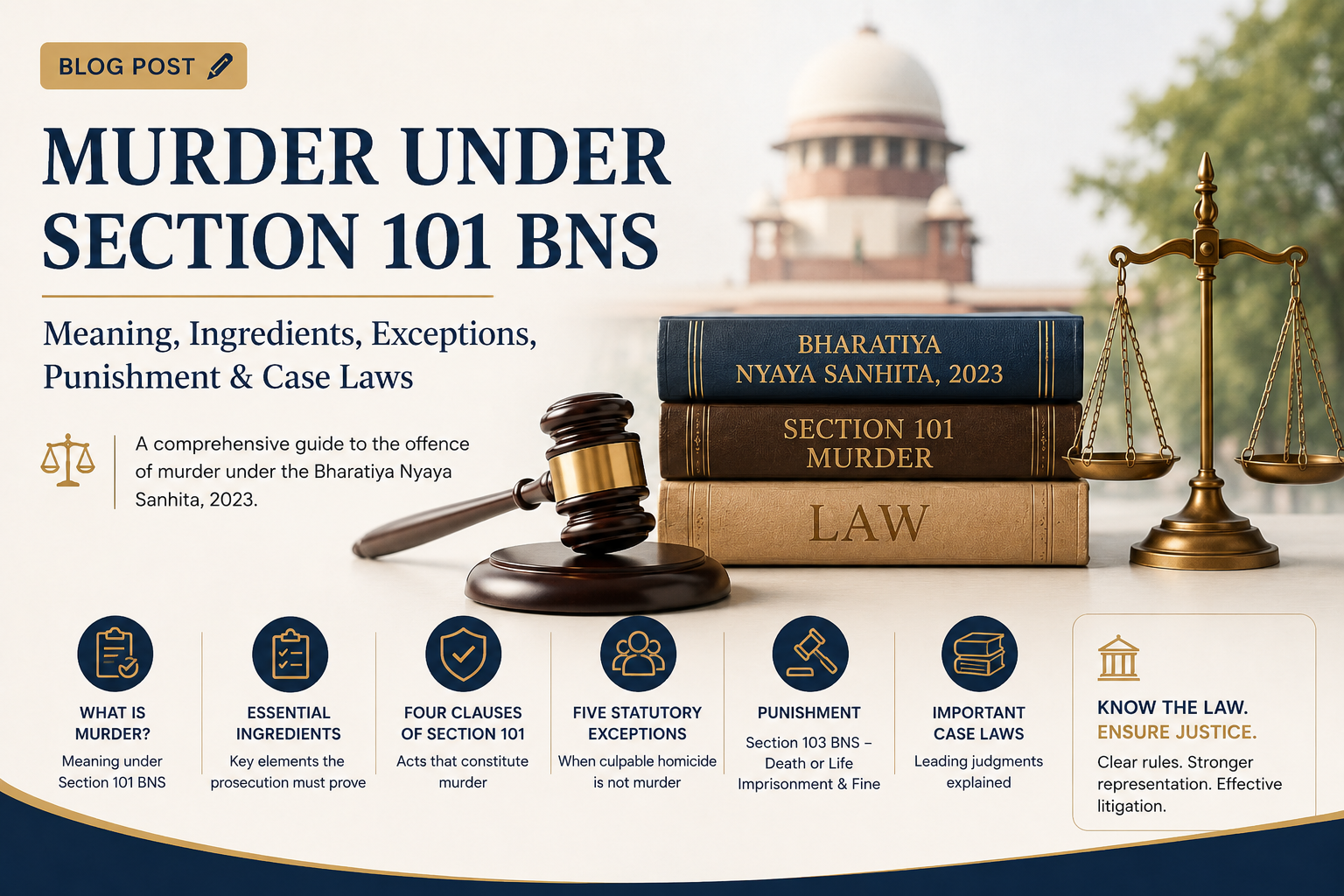
Section 101 of the Bharatiya Nyaya Sanhita, 2023: Murder
Introduction
The offence of murder occupies the most serious position among offences affecting human life. With the coming into force of the Bharatiya Nyaya Sanhita, 2023 (BNS) on 1 July 2024, the legal framework governing murder has been reorganised. Section 101 of the BNS defines murder, while Section 103 prescribes its punishment. Section 100 deals with culpable homicide, making the distinction between culpable homicide and murder central to the determination of criminal liability.
Section 101 substantially carries forward the principles previously contained in Section 300 of the Indian Penal Code, 1860 (IPC). However, the provision must now be read together with the BNS provisions on culpable homicide, punishment, attempt, general exceptions and the procedural framework under the Bharatiya Nagarik Suraksha Sanhita, 2023 (BNSS).
1. Statutory Position
Section 101 BNS is titled “Murder.”
It provides that, subject to the specified exceptions, culpable homicide amounts to murder when the act causing death falls within any of four circumstances:
the act is done with the intention of causing death;
the act is done with the intention of causing bodily injury which the offender knows to be likely to cause the death of that particular person;
the act is done with the intention of causing bodily injury and the intended injury is sufficient in the ordinary course of nature to cause death; or
the person knows that the act is so imminently dangerous that it must, in all probability, cause death, or bodily injury likely to cause death, and commits it without any excuse for taking that risk.
The corresponding provision under the IPC was Section 300, while the punishment earlier appeared under Section 302 IPC. Under the BNS, the corresponding provisions are broadly:
The BNS came into force on 1 July 2024.
2. Meaning of Culpable Homicide under Section 100 BNS
Understanding Section 101 requires first understanding Section 100.
Section 100 provides that a person commits culpable homicide if death is caused by an act done:
with the intention of causing death;
with the intention of causing bodily injury likely to cause death; or
with the knowledge that the act is likely to cause death.
Therefore, culpable homicide is the broader category, while murder is the aggravated form falling within the circumstances specified in Section 101.
The Supreme Court has historically explained this relationship by observing that all murders are culpable homicides, but not all culpable homicides are murders. The decisive question is the degree of intention or knowledge accompanying the act.
3. Essential Ingredients of Murder under Section 101
For establishing murder, the prosecution generally has to establish:
A. Death of a human being
There must be proof that the victim died.
Medical evidence, post-mortem findings, death certificates, eyewitness testimony and other admissible evidence may establish the fact and cause of death.
B. Death must have been caused by the accused’s act
There must be a causal connection between the accused’s conduct and the death.
The prosecution must establish that the act attributed to the accused caused or materially contributed to the death.
C. The act must fall within one of the four clauses of Section 101
It is not sufficient merely to establish that the accused caused death. The prosecution must establish the required intention or knowledge contemplated by Section 101.
D. The case must not fall within any of the five exceptions
Even where the ingredients of one of the four clauses are satisfied, culpable homicide will not amount to murder if one of the statutory exceptions applies.
This is an important feature of Section 101: the exceptions operate as a statutory qualification to what would otherwise constitute murder.
4. Clause (a): Intention to Cause Death
Section 101(a) covers cases where the act causing death was committed with the intention of causing death.
This is the clearest form of murder.
Example
A shoots Z with the intention of killing Z. Z dies from the shooting.
A’s act falls within Section 101(a).
The statutory illustration itself gives substantially this example.
Important point
The prosecution does not necessarily have to prove a long-standing or pre-planned intention.
The relevant question is whether, at the time of the act, the accused possessed the intention to cause death.
Therefore, a murder can occur even where the intention arose shortly before the fatal act.
5. Clause (b): Intention to Cause Injury Known to be Likely to Cause Death
Section 101(b) deals with a more specific form of knowledge.
The accused must:
intend to cause bodily injury; and
know that such injury is likely to cause the death of that particular person.
The special knowledge concerning the victim is important.
Example
Suppose Z suffers from a serious medical condition which A knows about. A intentionally inflicts an injury upon Z which A knows is likely to cause Z’s death because of that condition. Z dies.
A may be guilty of murder even if the same injury might not ordinarily have caused the death of a healthy person.
The statutory illustration to Section 101 specifically recognises this principle. (Cytrain)
Key distinction
Clause (b) focuses upon the offender’s knowledge concerning the particular victim.
Thus, evidence regarding:
the victim’s medical condition;
the accused’s knowledge of that condition;
previous threats or interactions;
nature and location of the injury; and
circumstances surrounding the attack
may become relevant.
6. Clause (c): Injury Sufficient in the Ordinary Course of Nature to Cause Death
Section 101(c) concerns an intentional bodily injury which is sufficient in the ordinary course of nature to cause death.
This is closely associated with the famous principle laid down by the Supreme Court in Virsa Singh v. State of Punjab, concerning the former Section 300 “Thirdly”.
The important principle is that the prosecution need not always prove an intention to kill if it establishes that:
a bodily injury was inflicted;
the accused intended to inflict that particular injury; and
that injury was objectively sufficient in the ordinary course of nature to cause death.
The Supreme Court has reiterated that even a single injury can constitute murder where these requirements are established.
Example
A intentionally inflicts a sword injury upon Z. The injury is objectively sufficient in the ordinary course of nature to cause death. Z dies.
Even if A claims that he did not specifically intend Z’s death, the case may fall under Section 101(c).
Importance of medical evidence
Medical evidence becomes particularly important under this clause.
The prosecution may rely upon:
post-mortem report;
nature and dimensions of injuries;
internal injuries;
weapon used;
anatomical location of injury;
cause of death;
medical opinion concerning sufficiency of injury to cause death.
However, medical evidence must be considered together with the entire evidentiary record.
7. Clause (d): Imminently Dangerous Acts
Section 101(d) applies where:
the accused knows that the act is so imminently dangerous;
the act must, in all probability, cause death or bodily injury likely to cause death; and
the accused nevertheless commits the act without any excuse for incurring the risk.
This clause deals principally with knowledge of the highly probable consequences of an act.
The emphasis is not necessarily upon an intention to kill a particular individual.
Example
A, without any lawful or reasonable excuse, fires a loaded cannon into a crowd and kills one person. The statutory illustration treats such conduct as murder.
The principle is that an individual cannot deliberately undertake an act carrying an obvious and extremely high probability of causing death and then avoid murder liability merely by arguing that no particular victim was selected.
8. Intention and Knowledge: The Central Test
One of the most important questions in a murder prosecution is whether the accused possessed the requisite intention or knowledge.
The Supreme Court has repeatedly emphasised that the court must examine the circumstances surrounding the act to determine the mental element.
Relevant factors can include:
nature of the weapon;
manner in which it was used;
part of the body targeted;
force used;
number of injuries;
whether the attack was repeated;
circumstances preceding the incident;
relationship between the parties;
conduct of the accused before and after the occurrence;
whether the act was sudden or premeditated; and
whether the accused had a legitimate explanation or defence.
The Supreme Court has stated that the true test is to determine the intention or knowledge of the accused in doing the act.
9. Five Exceptions to Murder under Section 101
The five exceptions are extremely important because an act may initially satisfy one of the four murder clauses but still be treated as culpable homicide not amounting to murder.
Exception 1 — Grave and Sudden Provocation
Culpable homicide is not murder where the offender, while deprived of self-control by grave and sudden provocation, causes the death of:
the person who gave the provocation; or
another person by mistake or accident.
However, the exception does not apply where the provocation:
was sought or voluntarily provoked by the offender;
arose from an act done in obedience to law or by a public servant lawfully exercising powers; or
arose from lawful exercise of the right of private defence.
Important considerations
The question whether provocation was sufficiently grave and sudden is a question of fact.
The Supreme Court has explained that courts may examine factors including the time gap between the provocation and the homicide, weapon used, number of blows and surrounding circumstances.
Important case
K.M. Nanavati v. State of Maharashtra, AIR 1962 SC 605
The Supreme Court extensively considered the doctrine of grave and sudden provocation and emphasised that the issue has to be examined in the factual circumstances of each case.
10. Exception 2 — Exceeding the Right of Private Defence
The second exception applies where:
the accused was exercising the right of private defence in good faith;
the accused exceeded the power given by law;
death was caused;
there was no premeditation; and
there was no intention to cause more harm than necessary for the purpose of defence.
Thus, an excessive use of force in genuine self-defence may reduce liability from murder to culpable homicide not amounting to murder, provided the statutory conditions are satisfied.
This exception must be distinguished from a case where the accused had no right of private defence at all
11. Exception 3 — Public Servant Exceeding Powers
This exception applies where:
the offender is a public servant or assists a public servant;
the act is done for advancement of public justice;
the public servant exceeds the powers conferred by law;
the public servant in good faith believes the act to be lawful and necessary for duty; and
there is no ill-will towards the deceased. The exception therefore requires good faith and absence of ill-will.
It is not a blanket immunity for public servants.
12. Exception 4 — Sudden Fight
Culpable homicide is not murder when it is committed:
without premeditation;
in a sudden fight;
in the heat of passion;
upon a sudden quarrel; and
without the offender taking undue advantage or acting in a cruel or unusual manner.
The law expressly provides that it is immaterial which party:
offered the provocation; or
committed the first assault.
Important distinction
A mere quarrel does not automatically bring a case under Exception 4.
The court must examine whether:
the fight was sudden;
there was no pre-planning;
the accused acted in the heat of passion;
there was no undue advantage; and
the conduct was not cruel or unusual.
13. Exception 5 — Consent of a Person Above 18
Culpable homicide is not murder when:
the deceased was above eighteen years;
the deceased consented to death or took the risk of death; and
the statutory conditions are otherwise satisfied.
The provision expressly limits the exception to a person above eighteen years.
The illustration clarifies that a child cannot give legally effective consent to his or her own death for purposes of this exception.
14. Murder versus Culpable Homicide Not Amounting to Murder
The distinction is one of the most important issues in Indian criminal law.
The Supreme Court has explained that the distinction involves the degree of probability of death and the degree of intention or knowledge.
A useful way of understanding the structure is:
Culpable homicide → Does it satisfy Section 101? → If yes, does any Exception apply?
If Section 101 is satisfied and no exception applies → Murder.
If the case falls within an exception → Culpable homicide not amounting to murder, subject to the applicable punishment under Section 105.
15. Murder versus Death Caused by Negligence
Not every death caused by another person’s conduct constitutes culpable homicide or murder.
Section 106 BNS deals with causing death by a rash or negligent act not amounting to culpable homicide.
The crucial difference is the mental element.
Murder
Requires the intention/knowledge contemplated by Section 101.
Death by negligence
Generally involves rashness or negligence without the intention or knowledge necessary for culpable homicide.
Therefore, an accidental death, medical negligence case or negligent act cannot automatically be characterised as murder merely because death occurred.
16. Murder versus Attempt to Murder
Section 109 BNS deals with attempt to murder.
Where the accused performs an act with such intention or knowledge that, had death resulted, the accused would have been guilty of murder, Section 109 may apply even if death does not occur.
Thus:
Death occurs + Section 101 ingredients established → Murder under Section 101, punished under Section 103.
Death does not occur + requisite intention/knowledge and overt act → Attempt to murder under Section 109.
17. Punishment — Section 103 BNS
Section 101 defines murder, but Section 103 provides the punishment.
Section 103(1) provides:
death penalty, or
imprisonment for life,
along with liability to fine.
The BNS therefore maintains the two principal punishments traditionally associated with murder.
Life imprisonment
Life imprisonment ordinarily means imprisonment for the remainder of the convict’s natural life unless lawfully remitted or otherwise modified under the applicable legal framework.
A separate provision, Section 104, deals with murder committed by a person already under a sentence of life imprisonment and provides death or imprisonment for the remainder of that person’s natural life.
18. Special Provision for Group Murder — Section 103(2)
One notable BNS development is Section 103(2).
Where a group of five or more persons acting in concert commits murder on specified identity-based grounds, including:
race;
caste;
community;
sex;
place of birth;
language;
personal belief; or
any similar ground,
each member of the group may be punished with death or imprisonment for life and fine.
This provision is particularly significant in the context of group killings and what is commonly described as mob lynching.
19. Classification of the Offence
Under the First Schedule to the BNSS, murder under Section 103(1) is:
Cognizable
Non-bailable
Triable by the Court of Session
The same classification applies to Section 103(2).
A cognizable classification permits arrest without warrant in accordance with the BNSS, while non-bailable does not mean that bail is legally impossible; it means that bail is not available as an automatic statutory entitlement and must be considered under the applicable bail provisions.
20. Role of Medical and Forensic Evidence
Murder prosecutions frequently depend upon a combination of medical, forensic and testimonial evidence.
Important evidence may include:
Post-mortem examination
The post-mortem may establish:
cause of death;
nature of injuries;
approximate timing;
whether injuries were ante-mortem;
weapon characteristics;
internal damage.
DNA evidence
DNA may connect:
accused;
victim;
biological material;
clothing;
weapon or crime scene.
Fingerprints
Fingerprints may connect the accused to relevant objects or locations.
Blood and biological evidence
Blood grouping and DNA analysis may assist in establishing links between the accused, victim and crime scene.
Digital evidence
Depending on the facts, relevant material can include:
CCTV footage;
mobile-location information;
call records;
messages;
photographs;
social-media communications;
electronic transactions; and
other electronic records.
The admissibility and evidentiary value of electronic material must be considered under the Bharatiya Sakshya Adhiniyam, 2023 (BSA).
21. Circumstantial Evidence in Murder Cases
A murder conviction does not necessarily require an eyewitness.
A case may be proved entirely through circumstantial evidence.
However, the circumstances must form a complete chain leading to the guilt of the accused.
The Supreme Court’s established principles in Sharad Birdhichand Sarda v. State of Maharashtra, (1984) 4 SCC 116, require the circumstances to be firmly established and collectively consistent with the guilt of the accused while excluding reasonable alternative hypotheses of innocence. The Court continues to apply these principles in contemporary cases.
Common circumstances may include:
motive;
last-seen evidence;
recovery of weapon;
recovery of articles;
conduct of accused;
extra-judicial confession;
forensic evidence;
CCTV footage;
call records;
location evidence;
blood/DNA evidence; and
subsequent conduct.
Important caution
Motive alone is generally insufficient to establish murder.
The prosecution must establish the offence beyond reasonable doubt through legally admissible evidence.
22. Single Injury Can Amount to Murder
An important misconception is that murder requires multiple injuries.
That is incorrect.
A single injury can constitute murder where the statutory requirements are fulfilled.
The Supreme Court has expressly recognised that where the accused intended to inflict the particular injury and that injury was objectively sufficient in the ordinary course of nature to cause death, murder may be established even though only one injury was inflicted.
Therefore, the number of injuries is only one circumstance and is not by itself determinative.
23. Relevant Case Laws
1. Virsa Singh v. State of Punjab, AIR 1958 SC 465
Principle
The case is the leading authority concerning the former Section 300 Thirdly, now substantially reflected in Section 101(c) BNS.
The important principle is that the prosecution must establish the particular bodily injury intended by the accused and that the injury was objectively sufficient in the ordinary course of nature to cause death.
Relevance to BNS: Section 101(c).
2. State of Andhra Pradesh v. Rayavarapu Punnayya, (1976) 4 SCC 382
Principle
The Supreme Court explained the relationship between culpable homicide and murder and emphasised that murder is the aggravated form of culpable homicide.
Relevance to BNS: Sections 100 and 101.
3. K.M. Nanavati v. State of Maharashtra, AIR 1962 SC 605
Principle
The case remains a leading authority concerning:
grave and sudden provocation;
loss of self-control;
time gap between provocation and killing; and
whether the accused had regained self-control.
Relevance to BNS: Exception 1 to Section 101.
4. Pulicherla Nagaraju @ Nagaraja Reddy v. State of A.P., (2006) 11 SCC 444
Principle
The Court discussed factors relevant to determining whether the accused possessed an intention to cause death, including the weapon, manner of attack, part of body targeted, force used and surrounding circumstances.
Relevance: Determination of intention under Section 101.
24. Burden of Proof in Murder Cases
The prosecution carries the fundamental burden of proving the guilt of the accused beyond reasonable doubt.
The prosecution must establish:
death;
identity of the accused, where disputed;
causal connection between the accused’s act and death;
the required intention or knowledge;
circumstances bringing the case within Section 101; and
where relevant, facts defeating any claimed statutory exception.
The accused is presumed innocent until guilt is established according to law.
Where the evidence leaves a reasonable doubt concerning an essential ingredient of the offence, the accused is entitled to the benefit of that doubt.
25. Defence of Exceptions
The five exceptions are particularly important from the defence perspective.
A defence may contend, depending on the facts, that:
the accused acted under grave and sudden provocation;
the accused exceeded the right of private defence without premeditation;
a public servant acted in good faith while exceeding lawful authority;
the death occurred during a sudden fight without premeditation or undue advantage; or
the deceased, being over eighteen, consented to the risk of death.
The applicability of an exception is determined on the evidence and circumstances of the individual case.
26. Death Penalty and the “Rarest of Rare” Principle
Although Section 103 permits the death penalty, death is not automatically imposed whenever a person is convicted of murder.
The constitutional jurisprudence of the Supreme Court has established the “rarest of rare” framework for determining when capital punishment is justified.
Therefore, a conviction under Section 103 and the question of sentence are distinct stages:
First: Is the accused guilty of murder?
Second: If yes, what sentence is appropriate?
The court must undertake a separate sentencing assessment before imposing capital punishment.
27. Important Practical Issues for Lawyers
In a Section 101/103 BNS murder prosecution, the following issues commonly require close examination:
Prosecution side
Establish cause of death.
Establish identity of accused.
Establish intention/knowledge.
Corroborate eyewitness testimony.
Establish weapon recovery where relevant.
Link forensic evidence.
Establish motive where relevant.
Complete the chain in circumstantial cases.
Address possible exceptions under Section 101.
Establish admissibility of electronic evidence.
Defence side
Challenge identity.
Test credibility of eyewitnesses.
Examine inconsistencies and omissions.
Challenge recovery evidence.
Examine chain of custody of forensic material.
Challenge forensic linkage where scientifically unsupported.
Examine medical evidence.
Question prosecution’s theory of intention.
Establish sudden fight/provocation/private defence where supported.
Challenge circumstantial evidence for missing links.
Raise reasonable doubt concerning causation or identity.
Distinguish murder from culpable homicide not amounting to murder.
28. Important Relationship Between Sections 101, 102, 103 and 105
These provisions should be read together:
Section 100
Culpable homicide
Section 101
Murder
Section 102
Culpable homicide where a person other than the intended person dies
Section 103
Punishment for murder
Section 104
Murder by a person already sentenced to life imprisonment
Section 105
Punishment for culpable homicide not amounting to murder
This structure makes the BNS framework easier to understand and apply.
29. Section 102 BNS — Death of a Person Other Than the Intended Victim
Section 102 is particularly relevant to murder cases.
It provides that where a person does an act intending or knowing it to be likely to cause death, but the death is actually caused to another person whose death the accused neither intended nor knew was likely to be caused, the culpable homicide is classified according to what it would have been had the intended or contemplated victim died.
This effectively addresses situations involving mistaken or unintended victims.
30. Key Takeaways
Section 101 BNS should be remembered through the following structure:
Culpable homicide + one of four clauses + no applicable exception = Murder.
Four clauses:
(a) Intention to cause death.
(b) Intention to cause bodily injury known to be likely to cause death of that particular person.
(c) Intention to cause bodily injury sufficient in the ordinary course of nature to cause death.
(d) Knowledge that the act is so imminently dangerous that it must, in all probability, cause death or such bodily injury, without excuse for taking the risk.
Five exceptions:
Grave and sudden provocation.
Excess of private defence.
Public servant exceeding powers in good faith.
Sudden fight without premeditation, undue advantage or cruel/unusual conduct.
Consent of a person above eighteen years.
Punishment:
Section 103 BNS — death or imprisonment for life and fine.
Classification:
Cognizable + Non-bailable + Triable by Court of Session.
Conclusion
Section 101 of the Bharatiya Nyaya Sanhita, 2023 preserves the fundamental structure of the traditional Indian law of murder while placing it within the new criminal-law framework. The provision does not make every unlawful killing murder. The distinction depends principally upon the nature of the act, intention, knowledge, probability of death, circumstances of the occurrence and the applicability of the five statutory exceptions.
For practical application, Section 101 must therefore be read together with Section 100 (culpable homicide), Section 102 (death of a person other than the intended victim), Section 103 (punishment for murder), Section 105 (culpable homicide not amounting to murder), the general exceptions under the BNS, the BNSS procedural provisions and the BSA provisions governing evidence.